

Light in the Darkness
Why protest? To cultivate political imagination — and “creative dissent,” in Martin Luther King Jr.’s words


This past Saturday morning, I saw a sundog through my bedroom window. The sun was still low and beyond the frame, the clouds rippled, but there it glowed through a scrim of leafless trees: a vertical patch of light.
I couldn’t believe it — really?! — I leapt up to look out another window, and it was still there, like one side of a brilliant parentheses around the rising sun. It lasted a few more moments before fading, as the sun kept moving upward, and its beams through “icy clouds” no longer created that ephemeral effect.
By the time I’d resettled with my first mug of coffee, the clouds looked matte gray; that strip of light, bright gold tinged with red and orange, the edge of a rainbow, was gone as if it had never been. But I knew it had been there. I knew that the joy I’d felt, my amazement at what the world can offer every day if you notice, was real.
And I kept that feeling with me, along with everything else I’d been wrestling with: rage and fear at ICE assaults in Minneapolis, the horror of a woman shot in the face and the resulting outcry, all undercut by government lies; the attack on Venezuela, threats against Greenland, continuing evidence that a fascistic, white-supremacist, deeply misogynist regime now rules my country.
I could go on. For most readers, I don’t need to belabor what happened to Renee Good and the aftermath. But on this Martin Luther King Day, I want to look harder at the hopelessness that can grind down activism.
I’ve had bad private moments. I won’t pretend I understand all or that I enjoy going to protests. Yet too many commentators talk about the pointlessness of protesting because we’ve done it all before and nothing ever changes. One recent article by a writer I usually admire set me off (I’ll get to it soon), but I bet you’ve seen others.
That’s why I nudged myself out the door last Friday for an event sponsored by a local ACLU chapter, the Urban League, and other Boston organizations called “Community Over Chaos: MLK Weekend Kickoff 2026.” I did this not just to show up but to remember the equivalent of that sundog — joy amid sorrow, the long march to a mountaintop we may not get to ourselves, to paraphrase Martin Luther King Jr.
One speaker at this event read from his last book, Where Do We Go From Here? Community or Chaos?, published in 1967. The book title poses a question many are asking now, but it’s this quote that struck me: “Let us be those creative dissenters who will call our beloved nation to a higher destiny.”
I’d heard “creative dissent” before, but the Boston event got me looking again at other key speeches by King, especially those in which he came out against the Vietnam War. He was criticized for this at the time, yet the moral stand he took indicates the lasting value of speaking out. On April 15, 1967, MLK opened a speech he gave in New York City to an estimated 125,000 antiwar protesters like so:
“I come to participate in this significant demonstration today because my conscience leaves me no other choice. I join you in this mobilization because I cannot be a silent onlooker while evil rages. I am here because I agree with Dante, that: ‘The hottest places in hell are reserved for those who, in a period of moral crisis, maintain their neutrality.’ In these days of emotional tension, when the problems of the world are gigantic in extent and chaotic in detail, there is no greater need than for sober thinking, mature judgment, and creative dissent.”
He could be addressing us today. While the recent protests I’ve attended have been energizing, acknowledging the outrage so many people feel, it’s the sundog moments I’m also reaching for. I’m trying to keep both the bad and good in mind: the ugliness of displays of macho dominance, the beauty of those who care for others — the corporate ravaging of the earth, the brilliance of clouds and sun and trees. Ephemeral as it may seem, the feeling of solidarity lingers.
The chaos of the 1960s provides context as well as a sharp reminder that these cracks in American democracy and ideology aren’t new. Yet in the New Yorker article that set me off last week, “What Comes After the Protests” by Jay Caspian Kang, this writer implies that protesting now is merely a nostalgic tic. His opening paragraph:
“Do Americans still believe in mass protest? Or do we just not know of any other possible mechanism, outside voting, for achieving social change? When we take to the streets — which we still do, in great numbers — do we expect something to come of it, or are we out there simply because our understanding of American history tells us that this is what we are supposed to do next?”
A friend sent me the link to Kang’s piece, wondering what I thought. Perhaps it does speak to others who feel weary or helpless. Kang, a New Yorker staff writer and 2024 Pulitzer finalist for his commentary, voices a common refrain. He’s surely clear-eyed about the dictatorial and benighted actions of the Trump administration. But my assumptions about social movements, as I texted my friend, are very different. For starters, I didn’t just read about them in school.
Kang’s references to past protests are more recent than the Civil Rights Movement (not to mention women’s liberation, anti-apartheid, anti-nukes, gay rights, union picket lines). He notes the rise and fall of Arab Spring, the current Iranian protests, the groundswell of Black Lives Matter resistance after George Floyd’s murder. He wonders why we keep showing up, if it’s just a feel-good exercise. But here’s the claim that really irritated me:
“The truth is that, thanks to the two-party system, relative economic comfort, and basic stability, many of us in America do not have much in the way of political imagination. Nostalgia certainly plays a role in our limited view — we are always re-creating the marches we learned about in history class — but it’s increasingly clear that the internet and social media also have a diluting effect on dissent, creating the illusion of strength through volume while somehow watering down everything in the process. We can tweet, go protest, and vote. That’s about it.”
At least he appears to include himself in those who lack political imagination. But as I so often tell journalism students, who is “we” in a sweeping statement like this? It’s not me. It’s not the people I’ve seen and rubbed shoulders with at protests. It was not those at the MLK event in Boston, where many of the speakers were BIPOC local politicians, entertainers, or youth workers. Protesting and voting aren’t empty shrugs. This puts the blame, even if unintentional, on individual cluelessness rather than on its proper target: an authoritarian regime set on terrorizing anyone who resists.
I’ll hazard a guess that Kang’s own despair got the better of him here. You see it in the series of impersonal rhetorical questions he asks. I want to nudge this excellent cultural critic to turn around “Do Americans still believe in mass protest?” to make a direct statement grounded in his own experience. What do you believe? Not every sensibility has been diluted by social media. You may well disagree with me but speak for yourself, as I speak for myself, because far from finding the history of protest movements to be enervating, their legacy charges me up with the moral authority of those who have gone before.
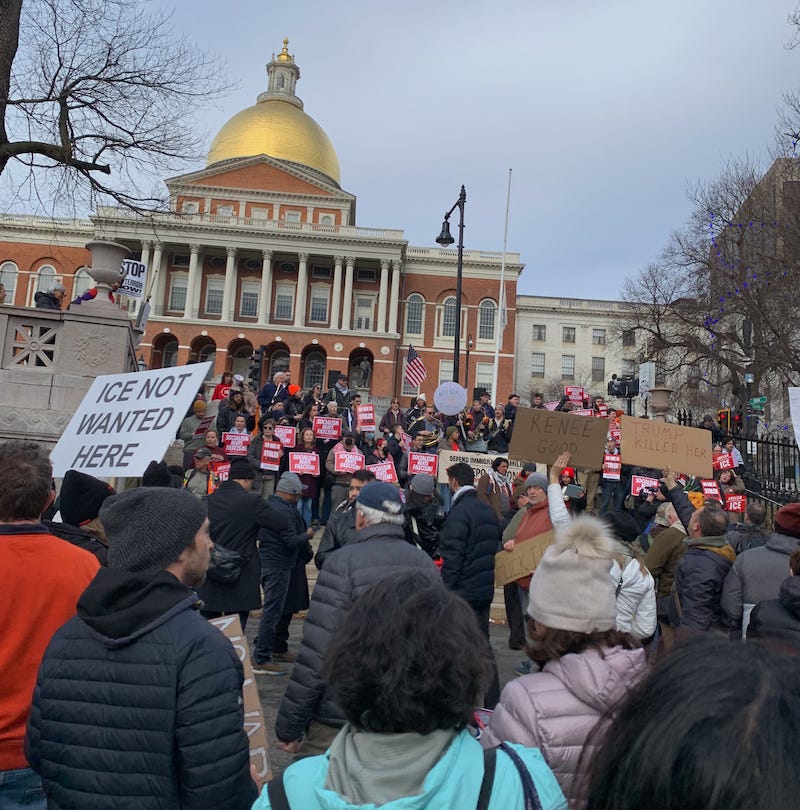
Why protest? The fact that so many people are resisting right now needs to be witnessed and shared, both in person and online. The point is that ordinary citizens see what a corrupt government is doing. Apparently even Trump is worried about the “optics” of masked goons grabbing people off the street as approval for ICE tactics plummets in polls. Protests counter the lies told by those in charge; they counter helplessness by seeing other people around you, even if individual participants grumble about the cold or feel they’re just going through the motions or are performing for social media. In an era when legacy news outlets can’t keep up or have been co-opted, documenting what you see in the real world matters more than ever.
Not every person has the time or ability to attend a street protest, but there are many, many ways to resist. Show up and witness however you can. That’s what I’m trying to do and what I see others in my orbit doing — and here, I only speak from my limited, privileged perspective. I don’t go to every protest or deportation-center vigil. But when I do, it’s not because I think protests make change happen instantly or that a corrupt regime can be toppled by chanting and waving signs.
I’d say the real lack of imagination comes in not envisioning how to work across political divides. I confess that, decades ago, I never would have imagined finding common cause with Bill Kristol of the Reagan/Bush administrations. But as a neo-conservative éminence grise on the Bulwark podcast last week, Kristol joked ”we’re all resist libs now.” Crossing opinion divides is what MLK did, when his critics believed he’d turned his back on Black power or the “revolution” of civil rights to stand against the Vietnam War and cozy up to the establishment. In a 1967 takedown of King’s Where Do We Go From Here? in the New York Review of Books, Andrew Kopkind opened: “The Movement is dead; the Revolution is unborn.”
Does that picking apart from the left sound familiar? It does to me, especially with echoes of that old review in Kang’s 2026 New Yorker column. Yet MLK did look beyond by calling the war abroad and injustice at home “inextricably linked.” In his “Beyond Vietnam — A Time to Break Silence” speech at Riverside Church in New York City that same April of 1967, a year before he was assassinated, he declared: “I was increasingly compelled to see the war as the enemy of the poor.”
The people in power do have power, and they will cling to it like zombies who never die. Still, I doubt most Americans today would say the country might as well go back to Jim Crow, lynchings, and chattel slavery. Determining the success of a growing national resistance movement based on immediate results is, to put it kindly, misguided. After many long decades protesting for equality, I refuse to forget how different this one-year anniversary of a disastrous presidency would be if a Black South-Asian woman had won. The fact is, Kamala Harris almost did win.
While I may not be on the streets of Minneapolis, I can also imagine how hard it is to be there — not only empathizing but refusing to ignore suffering. At the same time, I can try not to demonize enemies. That last is tough work, battling my desire to kick and lash out, recognizing how fragile most humans are. It requires the long view of Martin Luther King Jr. and Mohandas Gandhi in promoting nonviolent protest.
That is political imagination to aspire to. I’m a secular humanist, through and through, but I respond to calls to the spirit. I think religious leaders who emulate MLK, himself named for the most eponymous of protesters, know faith is about imagination — and that faith must be cultivated beyond a relentless focus on material gains and realpolitik. It must include moments of joy and communion. It is about creativity, converting so much feeling and a desire for change into light that blazes forth, however briefly.
Here, I’ll risk a rhetorical “we” to say we all have our sundog moments. This MLK weekend, I know many of the writers I follow on Substack have been sharing ideas and creative work — and reading, one of the best practices for building imagination. There were other protests along with community gatherings around the country. And on Saturday, San Francisco held a free public memorial for Bob Weir of the Grateful Dead, the ur-hippie jam band, which drew thousands to mourn and rejoice and imagine a better world.
In the midst of so much other turmoil, Weir’s death on January 10 saddened me. Yet recalling such a consummate musician and icon in the Bay Area of my youth was another sundog. The memorial opened with Buddhist monks droning a prayer. It led me to track down my favorite Dead songs going back to when I first saw them in the 1970s. A 1989 performance of “Fire on the Mountain” at the Oakland Coliseum — a grizzled Jerry Garcia rippling away on his guitar alongside young ponytailed Weir and Clarence Clemons on sax — still speaks to me, as surely as MLK’s words do:
You gave all you had, why you wanna give more?
The more that you give, the more it will take
To the thin line beyond which you really can’t fakeFire, fire on the mountain!
Fire, fire on the mountain!
Fire, fire on the mountain!
That same Saturday on the east coast, the morning I saw the sundog, it was snowing by late afternoon. Rain had been predicted, but when big, unexpected flakes started falling, I took a short walk. I did it to clear my head, to take in the sere beauty of black-and-white and every shade between — the snow that kept switching to freezing rain and sleet and back again to little melting crystals on my black jacket sleeves.

Additional Reading and Watching
A few shoutouts from my recent media mix — thank you all for your creative dissent. I’ll start with the many ways there are to resist what’s happening.
Minneapolis activism: “It’s Worse Than You Think and I Need Your Help” (Yes & Yes on Substack with suggestions)
SF Bay Area activism: “RISE UP: An Inescapable Network” (Natasha Beery’s newsletter for MLK weekend)
Cri de coeur for women: “An Ugly Carnival” by Dina Honour (American Woman on Substack)
Yes, it’s the misogyny: “Three Meditations on a Murder” by Susan Bordo (BordoLines on Substack)
More about MLK: “Martin Luther King, Jr., and the Vietnam War” (National Park Service video, Fort Monroe National Monument)
No, journalism isn’t working: “How to Build a Radically Truthful News Outlet” by Mark Jacob (Stop the Presses on Substack)
And let’s not forget Elon Musk, his creepy chatbot, and sexism on the internet: “The Problem Is So Much Bigger Than Grok” by Charlie Warzel (Galaxy Brain podcast with Sophie Gilbert, Atlantic)
And (surprise) AI is bad for us: “How Generative AI Is Destroying Society” by Gary Marcus (Marcus on AI on Substack about a recent paper by two law professors at Boston University)
Then there’s AI hype: “AI Companies Will Fail. We Can Salvage Something From the Wreckage” by Cory Doctorow (Guardian; sample quote: “AI is asbestos in the walls of our tech society, stuffed there by monopolists run amok.”)
RIP, Bob Weir: “Estimated Prophet” (Philadelphia, 1989)
(Okay, I admit it) an AI-generated video: “Greenland Defense Front — The Hungry Giant” (at least “demonflyingfox” makes AI use clear, and it’s catchy):
Actual humans marching: “Protesters in Greenland and Denmark Rally Against Trump Plan” (Globe and Mail / Reuters video)
We'll get more by confronting the Dems than GOP. I've had enough of their hand-wringing and mealy-mouthed denunciations. It's in their power to close the government down. They can refuse to participate until ICE is abolished.
Wonderfully written, insightful piece. And a reminder that the natural world offers the best antidote to hopelessness and despair, which is a reason to do all we can--yes, by protesting, among other things--to protect it.